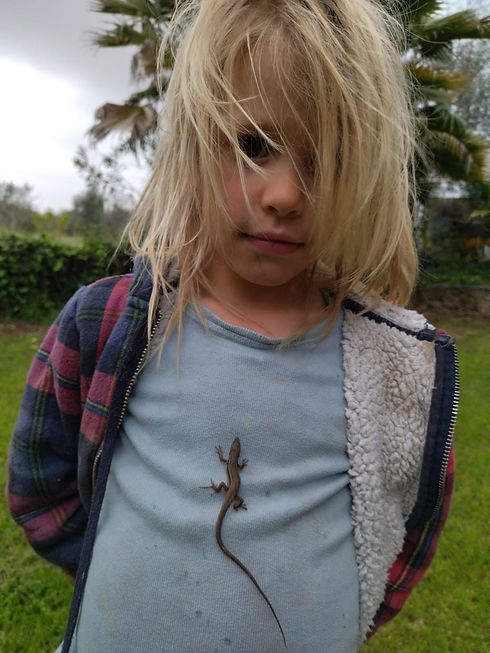
Child holding a small lizard on their shirt
Therapy and Support Services
I offer services for children, parents, and professionals - including therapy, guidance, and lectures - focused on the nervous system, emotional regulation, communication, sensory processing, and development.
My work is integrative and personalized, grounded in understanding the body, the nervous system, and the connections between us.
Therapy Sessions
I offer personalized therapy sessions for children of all ages, tailored to each child and family.
In our work together, we begin to understand the child from the inside - through the body, the nervous system, and their emotional world.
At the same time, I support parents in understanding themselves, so they can become a steady, regulating presence for their child.
Together, we explore what can support your child not only in challenging moments, but also in everyday life - and how to bring simple, practical tools into your home that create real change.
The goal is not only to help children get through difficult moments, but to support them in building lifelong skills: the ability to regulate, stay connected, face challenges, and feel at home within themselves and in relationship with others.

Child lying on the beach, smiling at a stack of stones

Limor Roitfarb giving a lecture
Lectures for Parents, Educators, and Therapy Teams
I offer lectures for parents, educators, and therapy teams on topics such as Polyvagal Theory, interoception, stress, sensory and emotional regulation, and Compassionate Communication (NVC).
In these lectures, we explore how the nervous system shapes our emotions, behavior, and communication - and how learning to work with it helps us find an anchor within ourselves, even in challenging moments, and stay connected to others.
Participants gain both understanding and practical tools to support regulation, improve communication, and create safer, more supportive environments for children.
Workshops for In-Depth Learning
In addition to lectures, I offer hands-on workshops that deepen understanding and bring these concepts into real-life practice.
In these workshops, participants explore the nervous system, interoception, and ways to use tools like the SENCIAH Kit in a practical, embodied way.
These are spaces for learning, experiencing, and practicing - where understanding turns into something you can actually use.
Participants leave with clear, practical tools they can bring into their work with children, families, clients, and teams.

Child sitting on the beach with a dog lying nearby

Child using the Safe and Sound Protocol (SSP) with headphones and a weighted blanket
Safe and Sound Protocol (SSP)
The Safe and Sound Protocol (SSP) is a listening-based therapy developed by Dr. Stephen Porges, grounded in Polyvagal Theory.
It uses specially filtered music, with the ear serving as a portal into the nervous system, to gently support regulation, safety, and connection - to oneself and to others.
SSP can be understood as a neural exercise that helps build new pathways of safety in the brain, supporting flexibility, resilience, and a greater sense of ease.
SSP is more than listening to music.
It is a guided process that creates a supportive space for the brain and body to work together, strengthening integration over time.
As the nervous system begins to feel safer, it becomes easier to connect, regulate emotions, and respond to the world with more flexibility.
I incorporate SSP into my work with children and adults - especially sensitive individuals, and those on the autism spectrum - to support challenges related to anxiety, sensory sensitivities, emotional regulation, sleep, and stress, creating a foundation for growth and well-being.
What is the SSP? a link to Unyte website

DIR/Floortime Approach
DIR® (Developmental, Individual-differences, Relationship-based) is a model developed by Dr. Stanley Greenspan that helps us understand how each person develops, experiences the world, and learns.
At its core, DIR highlights the central role of relationships and emotional connection in development.
By understanding a child’s developmental stage (D) and their unique individual differences (I), we can use relationships (R) to support growth, learning, and overall well-being.
DIRFloortime® (Floortime) is the practical application of this model.
It focuses on meeting the child where they are, building connection, and supporting development through shared experiences, play, and interaction.
This approach is widely used with children facing developmental, emotional, or social challenges, and is especially known for supporting children on the autism spectrum - with an emphasis on connection, communication, and emotional development.

Two children smiling in the rain, wearing raincoats, with a village and hills in the background